




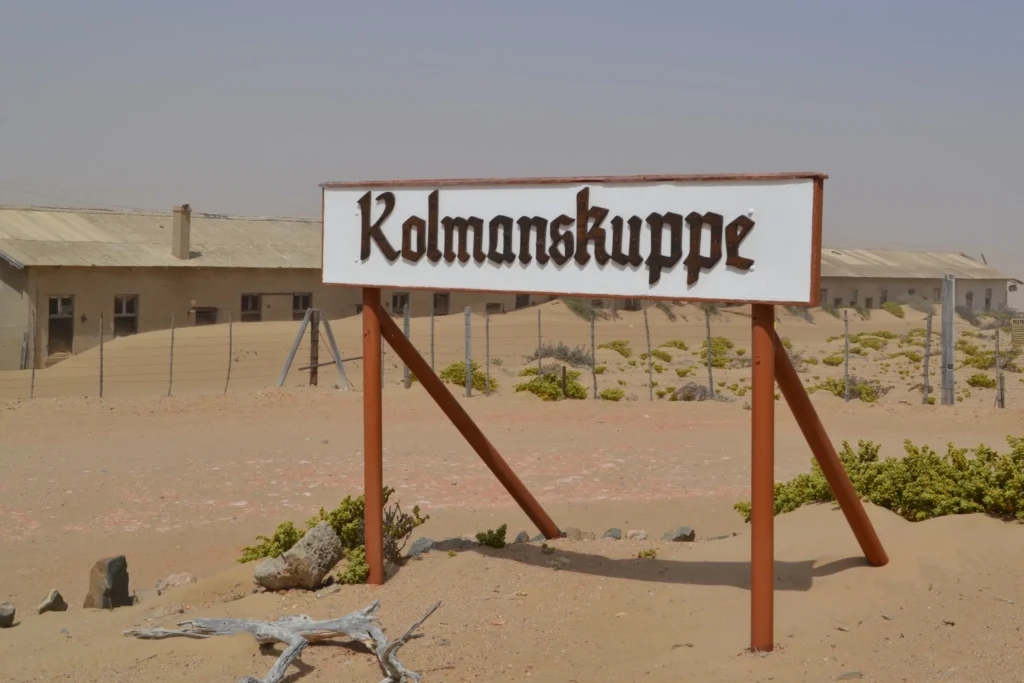
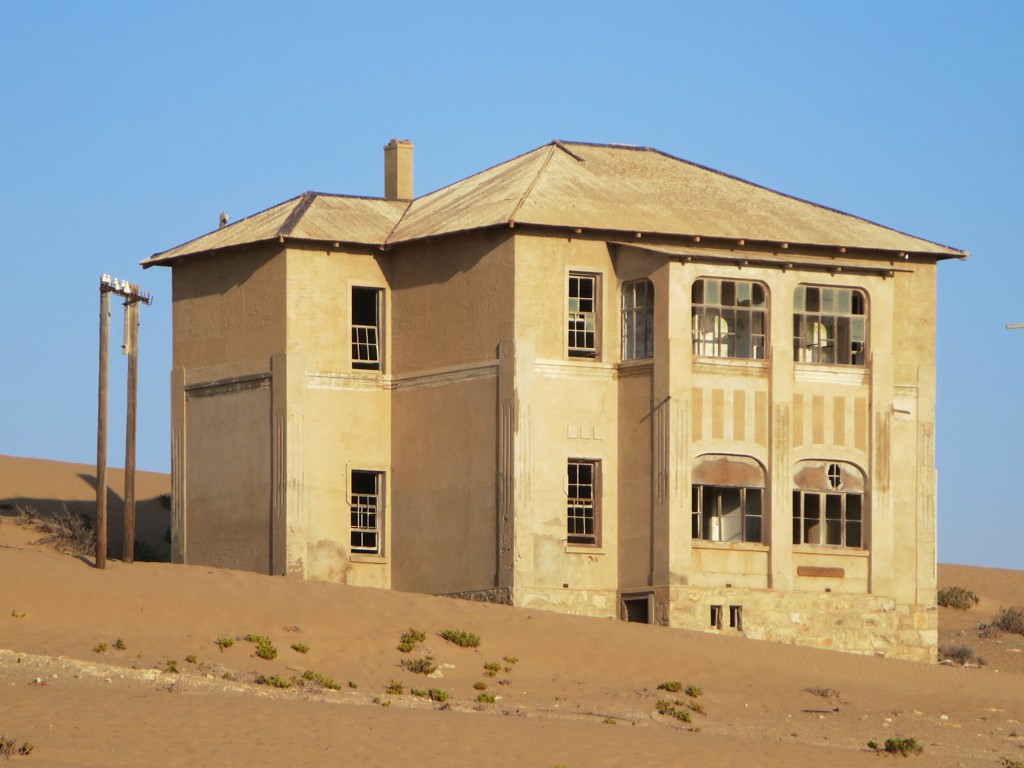
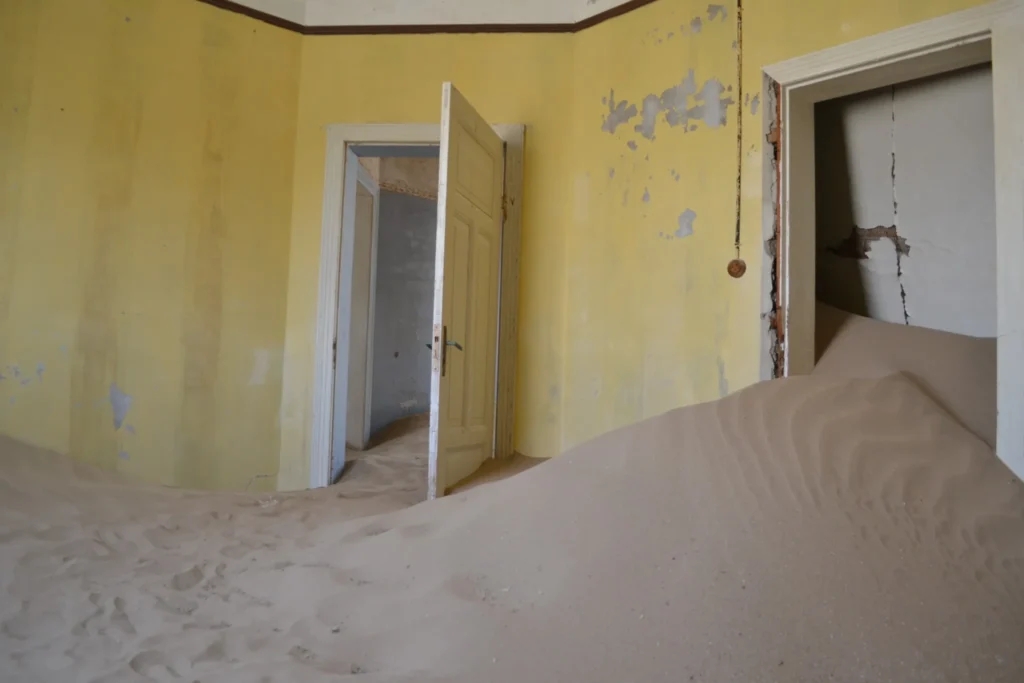
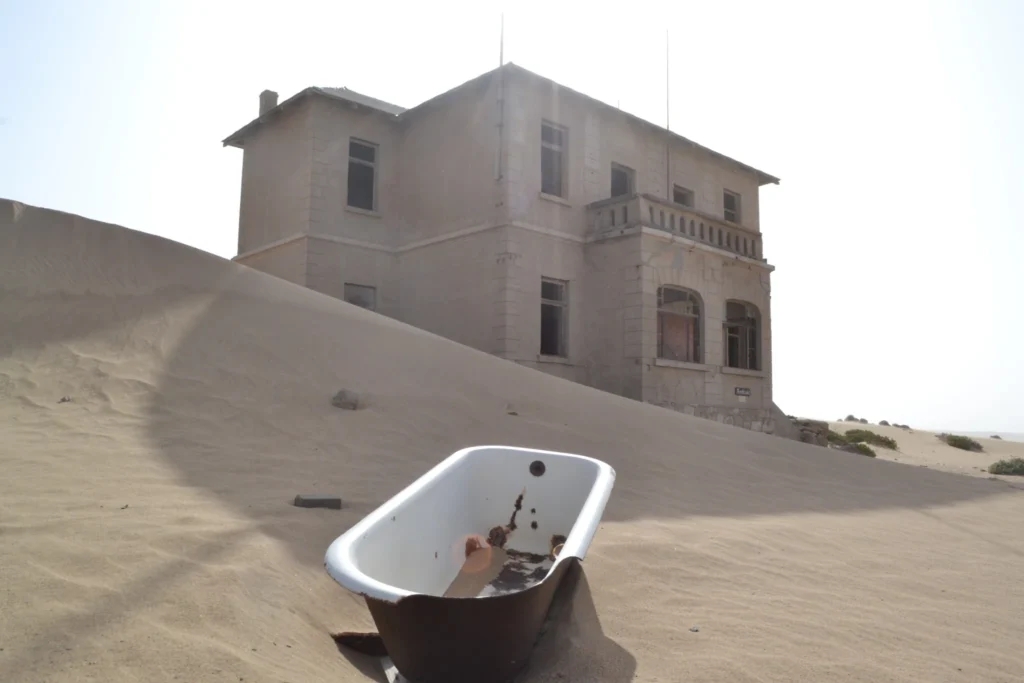
Ten kilometres east of Lüderitz, a cluster of empty houses rises from the Namib like a town caught halfway between architecture and dune. Kolmanskop is one of Namibia’s most recognisable places, but the sand-filled rooms are only the final chapter of a much stranger story: a railway worker’s diamond discovery, a tightly controlled colonial mining boom, a purpose-built desert settlement and a remarkably fast decline.
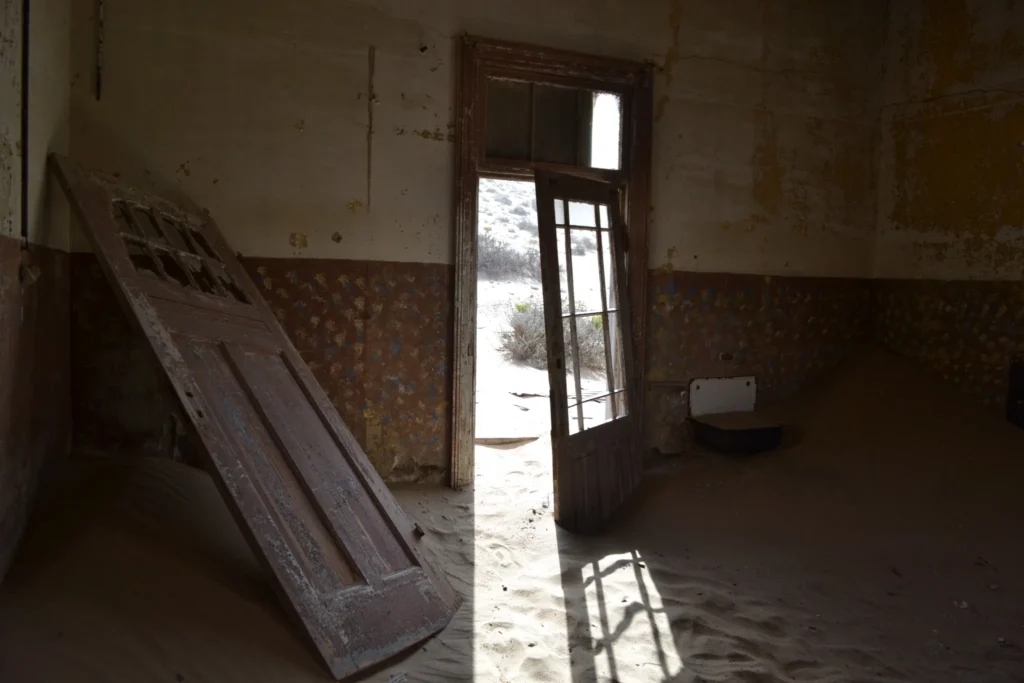
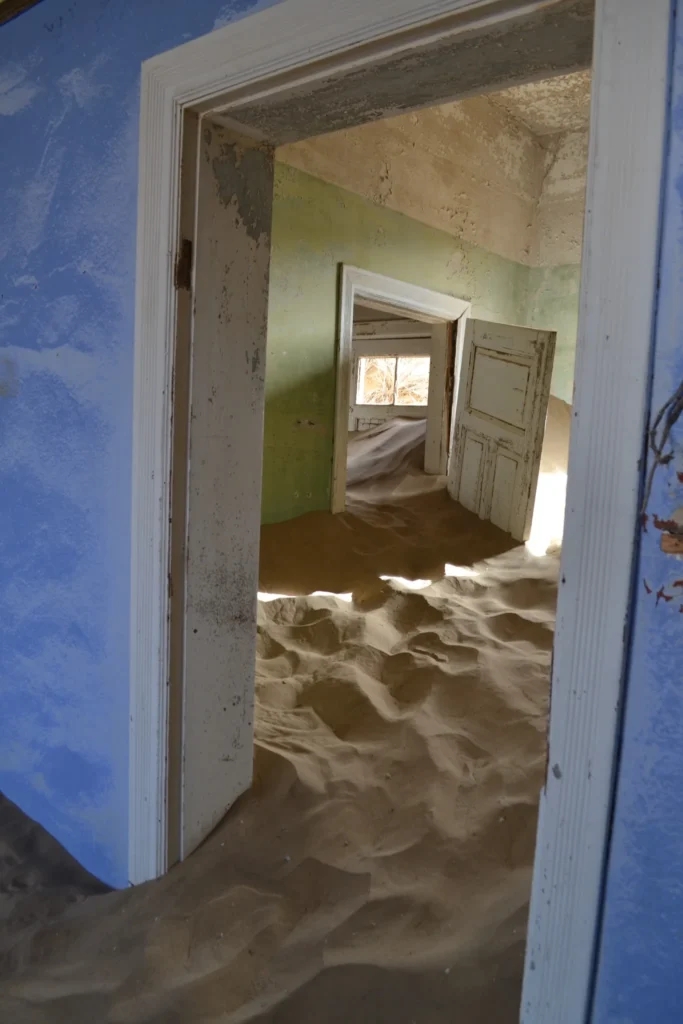
Today, visitors can walk through houses where dunes push through doorways, see surviving pieces of the settlement’s infrastructure and join an official tour that explains how a place built around some of the richest diamond fields of its era became a ghost town in less than half a century.
A diamond beside the railway changed everything
Kolmanskop’s modern story begins in April 1908. Zacharias Lewala, a railway worker clearing sand from the line between Lüderitz and Aus, picked up a glittering stone and showed it to his supervisor, August Stauch. The find was confirmed as a diamond and news triggered a rush into the surrounding desert. The Geological Survey of Namibia has described Lewala’s discovery as the find that confirmed diamonds in the area; within months, prospecting and mining were transforming the coast.
The German colonial administration soon declared a vast coastal area a Sperrgebiet, or prohibited area, restricting access and concentrating mining rights. Kolmanskop developed beside the railway into a company town. What began with rough shelters and corrugated structures quickly gained substantial houses, workshops, a hospital, school, ice factory, shops, entertainment facilities and an industrial network tied to the diamond fields. Visit Namibia describes the settlement as a rapidly growing German-style town created by the enormous wealth of the early diamond boom.
Want to see the archival town?
The Kolmanskop historical gallery includes archival photographs from the 1908–1930 diamond era, including mining equipment, early streets, the school and the casino.
A wealthy town, but not an equal one
The restored villas and ornate public buildings can make Kolmanskop look like an isolated pocket of European luxury. That is part of the story, but not the whole story. The diamond economy existed within German colonial rule and depended on a large labour force that did not share the same living conditions as the managers and skilled employees whose houses dominate the surviving townscape.
Accounts of Kolmanskop’s peak years describe roughly 400 residents in the main settlement and about 800 contract workers from Ovamboland housed separately in a compound. National Geographic also notes the unequal colonial context surrounding the diamond boom and that Lewala himself was not rewarded for the discovery that transformed the region. Remembering that wider labour history matters when looking at the town today: the elegant homes tell us who held status, while much of the workforce lived outside the part of Kolmanskop now visited by tourists.
Why Kolmanskop was abandoned
Kolmanskop did not disappear because the desert suddenly overwhelmed it. The economic centre of Namibia’s diamond industry moved. After the First World War, the local fields became less productive, and far richer deposits were discovered farther south toward the Orange River. Mining activity and equipment increasingly shifted toward what became Oranjemund. The worldwide economic downturn of the early 1930s accelerated the decline.
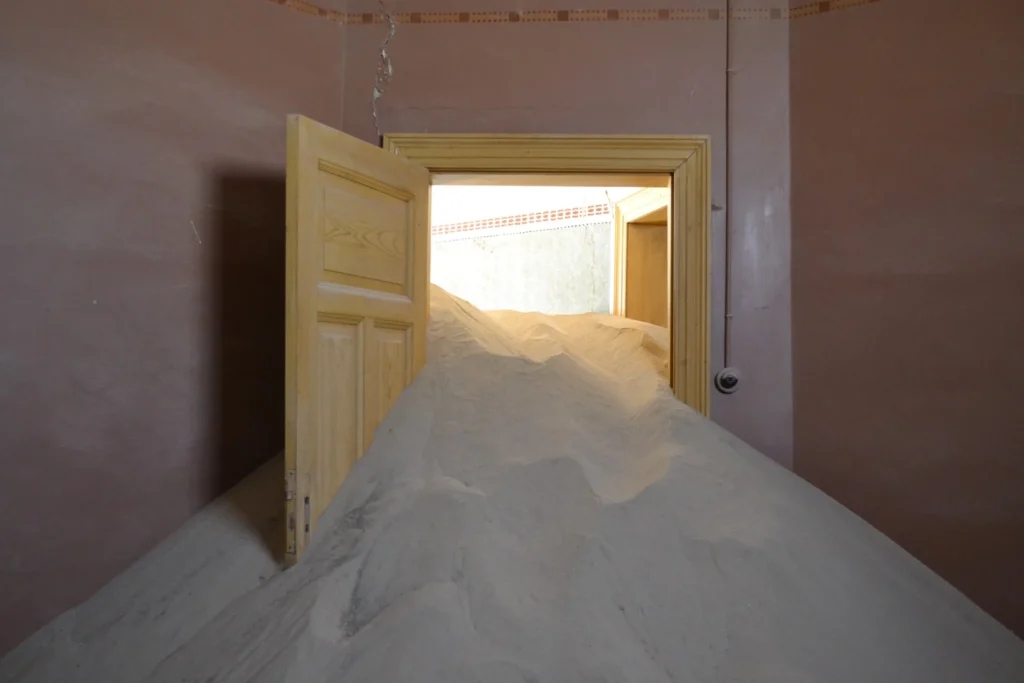
By the 1940s, Kolmanskop had lost much of its original purpose. The final families left in 1956. Once people stopped clearing sand from the streets and buildings, the Namib resumed a process that had never really stopped. Wind pushed sand through broken windows and doors, rooms filled, roofs failed, fixtures were removed and the settlement became the extraordinary ruin visitors see now. A detailed chronology is available in the Kolmanskop history archive.
Fun fact
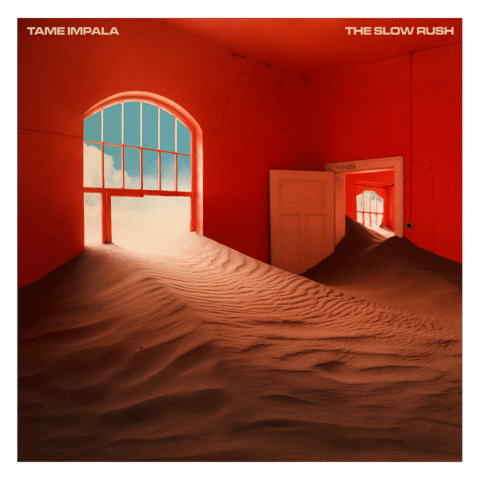
Kolmanskop became a Tame Impala album cover
For Tame Impala’s 2020 album The Slow Rush, photographer Neil Krug travelled to Kolmanskop with Kevin Parker and photographed several of the abandoned interiors. The images were then colour-treated into the vivid, surreal reds and blues used across the album and its singles.
The sand-filled room on the cover is therefore not a studio set: it is a real Kolmanskop interior. The setting also fits the album’s recurring ideas of time, change and things being slowly overtaken.
Read about the Kolmanskop artwork shoot or see the official album page.
How to visit Kolmanskop today
Access is straightforward by Namibian standards. Kolmanskop is about 10 km east of Lüderitz beside the paved B4, and the turn-off is signposted. A standard car can reach the entrance; you do not need a 4×4 simply to drive from Lüderitz to the site. The important detail is the permit: Kolmanskop lies inside the restricted diamond area and your ticket functions as your permit.
Current 2026/2027 visitor information
Permits can be purchased online, at the entrance gate or in Lüderitz at Desert Deli. The operator states that drones are not allowed and visitors may not cross the boundaries into the surrounding mining area. Official guided tours inside Kolmanskop are conducted by Ghost Town Tours guides. If photography is a priority, the extended photographer permit is the better choice because it gives access to the low morning and evening light that makes the sand-filled rooms especially dramatic.
Allow at least two to three hours if you want the guided history and enough time to explore the buildings at a relaxed pace. Closed shoes are sensible: the site is a genuine ruin, with uneven surfaces, broken materials and deep sand in some rooms.
Planning Kolmanskop with Zumi
Kolmanskop works particularly well as part of a wider southern Namibia route rather than as an isolated stop. Lüderitz, Diaz Point, the wild horses near Aus and the long desert drive south can all be built around the visit.
Zumi Rentals + Tours can help with the practical side: we can assist with Kolmanskop ticket and permit arrangements, coordinate the appropriate scheduled or private tour with the authorized on-site operator, help with transport to and from Lüderitz, and build the stop into a wider itinerary. That support is available for individual travellers, couples and small groups as well as private groups that want a more organized visit. Where an official guided tour inside Kolmanskop is required, the historical tour itself is conducted by the authorized Ghost Town Tours guides; Zumi can handle the surrounding transport, booking coordination and trip planning.
If you are planning a southern Namibia trip and want Kolmanskop included without having to coordinate each piece separately, start planning with Zumi Rentals + Tours and tell us your travel dates, group size and whether you want a standard visit, private arrangement or photographer access.
Additional image credits: Photo: David Stanley / Wikimedia Commons, CC BY 2.0. Resized by Zumi Rentals + Tours. License.